

Cooling towers contaminated with Legionella bacteria found at Sofina Foods Ltd., a meat processing plant in London, Ontario have been linked to multiple outbreaks of Legionnaires’ disease during the summers of 2024 and 2025.
An investigation by the Middlesex-London Health Unit revealed that the subtype of Legionella found at the Sofina Foods plant matched the strain responsible for infecting several people. Siskinds LLP is representing those affected in a class action lawsuit against Sofina Foods, seeking accountability and support for those who suffered illness or lost loved ones as a result of the outbreaks.
What is Legionnaires’ disease?
Legionnaires’ disease is a severe and potentially life-threatening form of pneumonia caused by the Legionella bacteria. It primarily affects the lungs and can lead to severe respiratory illness, requiring hospitalization. What distinguishes Legionnaires’ disease from other types of pneumonia is its bacterial origin and its frequent association with contaminated man-made water systems, such as cooling towers, hot water tanks, plumbing systems, and decorative fountains.
Symptoms of Legionnaires’ disease
Symptoms of Legionnaires’ disease usually begin two to ten days after the inhalation of Legionella bacteria and can last for several weeks to several months. Delaying medical care in these situations can cause symptoms to worsen and have severe consequences. Symptoms of Legionnaires’ Disease include:
- Pneumonia;
- high fever;
- chills;
- dry cough;
- loss of memory;
- confusion;
- delirium;
- hallucinations;
- muscle aches; and
- headaches
Complications of Legionnaires’ disease can result in respiratory failure, shock, kidney failure, sepsis, and multi-organ failure.
These symptoms and complications can be serious and life-threatening.
Symptoms of Pontiac fever
A less severe form of Legionella infection results in Pontiac fever. Pontiac fever is a mild, flu-like illness. Symptoms of Pontiac fever include:
- Fever;
- headaches; and
- muscle aches
These symptoms usually begin after 5 hours but can appear up to 72 hours after exposure to Legionella bacteria. Pontiac fever usually lasts for two to five days.
Current status of the Legionella outbreak in London
The current outbreak is ongoing, and cases are still being reported by the Middlesex-London Health Unit.
An investigation by the Middlesex-London Health Unit found that the subtype of Legionella discovered at the Sofina Foods plant matched the subtype causing severe illness in 96 people and the death of 5 people in 2025.
During a related outbreak of the same bacterial sub type in 2024, 30 individuals contracted Legionnaires’ disease, 2 of whom lost their lives as a result of their illness.
Where did the Legionnaires’ outbreak originate?
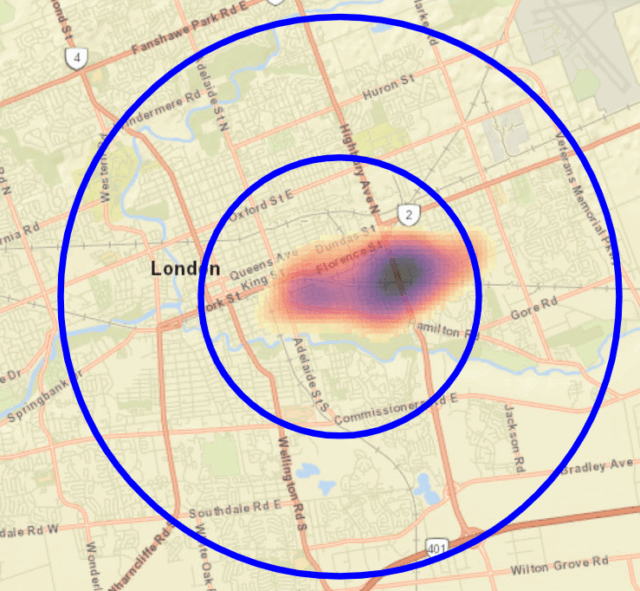
All the individuals who contracted Legionnaires’ disease in the outbreak of Summer 2025 reside within a 6-kilometre radius of the Sofina Foods plant, with the vast majority residing within a 3-kilometre radius.

Timeline of Legionnaires’ outbreaks in London
Summer 2024
- The Middlesex-London Health Unit declared a local outbreak of Legionnaires’ disease within a 5-kilometre radius in the southeast side of London
- Between May 1, 2024, and September 26, 2024, a total of 30 cases of Legionnaires’ disease were reported. Nine of these cases required admittance to the Intensive Care Unit of the hospital, and two people died
- Middlesex-London Health Unit collected samples from 18 cooling towers in the area
- The source of the outbreak remained undetermined at the time the 2024 outbreak was declared over
Summer 2025
July 8, 2025
- The Middlesex-London Health Unit declared an outbreak of Legionnaires’ disease within a 6-kilometre radius of the southeast side of London
August 6, 2025
- The outbreak is declared over after several weeks of no new infections
- The case count stood at 70 confirmed cases of Legionella infection, three of whom had died
August 26, 2025
- The outbreak is redeclared after 25 new cases of Legionella infection were reported
- The Middlesex-London Health Unit collected a total of 160 samples from 49 cooling towers over the course of their investigation. Investigators named a meat processing plant owned by Sofina Foods, Ltd., as the source of the 2024 and 2025 outbreaks. This determination was made by matching the subtype of bacteria found in the cooling tower at the Sofina Foods facility to the subtype of bacteria causing Legionella infections in the area
September 9, 2025
- 105 confirmed cases of Legionella infection have been reported over the summer. Five of these individuals died from their illnesses.
How Siskinds LLP can help
Siskinds LLP is seeking to recover compensation for people in relation to illness or injuries allegedly arising from the Legionnaires’ disease outbreak in London, Ontario. This class action seeks to recover damages on behalf of people who suffered illness and/or death as a result of contracting Legionnaires’ disease or Pontiac fever from a Legionella bacterial infection. This class action does not currently include employees of Sofina Foods.
If you or someone you know has suffered a Legionella bacterial infection after spending time in the south-eastern area of London, Siskinds may be able to help. Visit the Legionnaires’ Disease Outbreak class action page, click “Join” to complete the form at the bottom of the page, or call 1.800.461.6166.
This article was written by Linda Visser (partner) and Michael Brown (articling student).